JDC Archives Completes Project to Digitize and Preserve the Film Collection of Moses A. Leavitt
Never-before-seen moving images of JDC’s dramatic 1940–50s history revived.
Slava Mitsel, Photo and Film Archivist, JDC Archives
The JDC Archives is thrilled to announce the completion of a five-year project to digitize and preserve the film collection of Moses A. Leavitt, past Executive Vice Chairman of the American Jewish Joint Distribution Committee (JDC).
This remarkable collection was donated to the JDC Archives by Moses A. Leavitt’s surviving grandchildren, Faye Zuckerman and Laurence Zuckerman. Mr. Zuckerman, a former journalist, is a JDC history enthusiast who has spent many hours conducting research in the JDC Archives. Along with the reels, the donation included Leavitt’s valuable notes and a diary describing in detail every reel in the collection.
Moses A. Leavitt was born on the Lower East Side of Manhattan in 1894 and grew up in Brownsville, Brooklyn. He attended Boys High School and Cornell University, graduating in 1916 with a degree in chemical engineering. After working at a few chemical factories in New Jersey and finding it unsatisfactory, he became a social worker, joining the Jewish Social Service Association in 1923 and the JDC in 1929 as Assistant Secretary, today’s equivalent of Deputy Executive Director. After a stint as Vice President and Secretary at the Palestine Economic Corporation between 1933 and 1939, Leavitt returned to the JDC as Secretary in 1940 and worked there until his death in 1965. He was named Executive Vice Chairman in 1947, playing a key role in postwar programs, aiding survivors in the DP camps in Europe and Jews in North Africa and the Middle East. In 1952, Leavitt was the lead negotiator for the Conference on Jewish Material Claims Against Germany (Claims Conference) in the talks that led to the groundbreaking compensation agreement with Germany for its crimes during the Shoah. It was while attending a Claims Conference meeting in Geneva that he suffered a stroke and died on June 21, 1965.
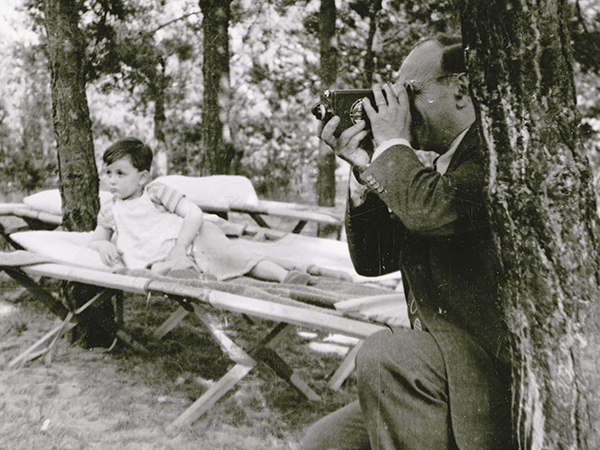
Moses Leavitt with his movie camera during a 1947 visit to Poland. Otwock, Poland, 1947. JDC Archives, NY_01871
This extraordinary film collection consists of 23 color raw-footage reels from 1941 to 1960 with the majority of the material originating from the decade immediately following WWII. These films served not only as Leavitt’s personal “home videos,” but also as his way of documenting the many journeys he undertook as a JDC executive. “My grandfather devoted his life to JDC,” Mr. Zuckerman said. “It is difficult to separate our family movies from his work films. For example, my grandmother, Fannie Fishelson Leavitt, appears in many shots and so, on one occasion, does my mother as a teen, when the family visited Cuba in 1942 where JDC was helping many European refugees.” The reels present a diverse array of topics that illustrate Jewish life and experiences, featuring rare documentation of some lesser-known Jewish communities. Some highlights include multiple trips to the nascent State of Israel (1949-1956) touching on topics such as tent camps for the arriving immigrants and JDC’s programs supporting the elderly.
Other reels focus on the immediate post-WWII period showing displaced persons camps as well as JDC’s efforts to provide aid to the Jewish survivors in Central and Eastern Europe. There are also several reels showing rare footage of JDC’s institutions supporting Jewish schools and kindergartens in Morocco and Tunisia. Remarkably, the footage captures significant moments in Jewish history, such as Leavitt attending a conference that ultimately led to the Luxembourg Agreements signed by West Germany and the Claims Conference—aimed at compensating victims of Nazi persecution—or the footage documenting the flight of Hungarian Jews into Austria after the 1956 Hungarian Uprising and Soviet invasion.
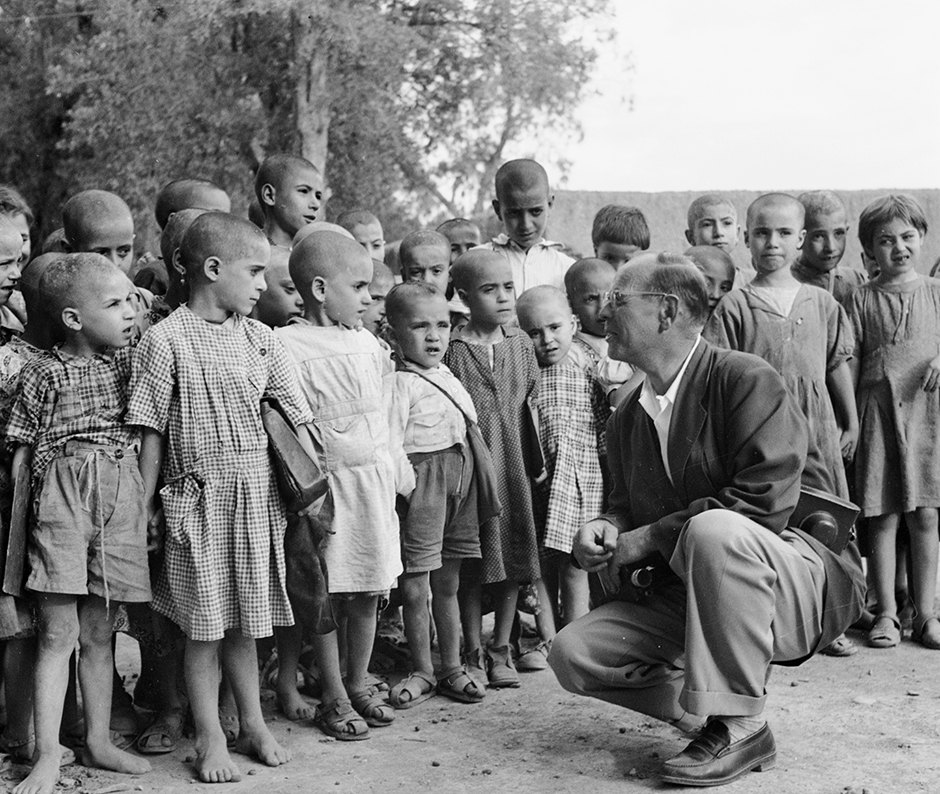
Moses Leavitt with children attending the school of the Alliance Israelite Universelle. Taroudant, Morocco, 1950s. JDC Archives, NY_12940
Through Leavitt’s camera, we catch vivid glimpses of well-recognized personalities of the era such as Israel’s prime ministers David Ben-Gurion and Golda Meir, Swiss Jewish leader Saly Mayer, the leader of the Reform Judaism movement Rabbi Jonah B. Wise, Hungarian President Zoltan Tildy, Queen Elizabeth II, King Paul of Greece with wife Frederica of Hanover, and American composer Larry Adler.
Finally, the importance of the personal “home video” should not be understated because while it may not show JDC programs, it captures Leavitt’s colleagues and travel companions, including Charles H. Jordan and Dr. Joseph J. Schwartz, who held numerous senior roles within JDC and served respectively as Head of the JDC Emigration Department in Paris from 1948 to 1955, and Director of European Operations from 1940 to 1949.
The digitization and preservation of the collection were made possible through three primary sources of support over the past five years: multiple grants from the National Film Preservation Foundation (NFPF), a nonprofit organization created by the U.S. Congress to help save America’s film heritage; JDC’s Henry and Marilyn Taub JDC Archives Film, Video, and Audio Project; and funding from donor Laurence Zuckerman, Moses A. Leavitt’s grandson.
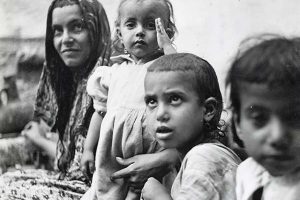
Children in DP camps and a Lag B’Omer celebration. Excerpt from “Post-World War II Germany, Austria, and Poland, 1947,” silent film by Moses Leavitt. JDC Archives
There are characteristics that make this collection of moving images truly unique. Despite being a high‑ranking JDC executive, Leavitt genuinely loved the process of filmmaking, and in most cases, was the operator of the camera. One would expect a designated cameraman to accompany the executives; however, Leavitt preferred to keep the camera in his own hands. While, he might not have visited every Jewish community where JDC operated, Leavitt had the most comprehensive bird’s eye view of the global Jewish world at the time, and he lugged his cameras with him to document it, making this footage all the more valuable. Leavitt was also, in many ways, an early adopter, embracing the newest technology. Leavitt would bring on his long journeys a 16 mm camera despite being a more cumbersome camera than the more common 8 mm consumer camera of the time. In return, we have been rewarded with a sharper image than could have been typically captured by non-professional filmmakers. Leavitt also began using the color Kodachrome film in 1941, which was a relatively new format in that day.
The unusual combination of someone in a senior leadership role with exceptional access to people and places, who also had a personal passion for filming, resulted in a collection filled with materials that are “rare” and “one-of-a-kind.” For example, Leavitt’s collection has the only post-WWII color footage of Poland in the JDC Archives, which depicts the rubble of the Warsaw ghetto in May of 1947. Another example is the rare footage of the construction of the Givat Ram campus of Hebrew University in 1956.
Descriptions of the reels are available on our List of Digitized Films, Videos, and Audio Recordings page.
Access to review the reels is reserved for filmmakers, museum curators, and academic researchers via written request. The footage from the Moses Leavitt collection has already sparked considerable interest and has been featured in several documentaries, among them Souvenirs of Absence (2025), Mizrahim (2023), and Reckonings (2022).