Rabbi Joseph Lookstein’s Postwar Mission to South America
A scrapbook captures his speaking tour urging Latin American Jewry to support JDC relief work in Europe.
Abra Cohen, Artifacts Curator and Outreach Coordinator
Immediately following World War II, JDC appealed to global Jewish communities for help funding its relief efforts benefiting the liberated Jews of Europe. In the summer of 1945, a few months after the end of the hostilities in Europe, JDC enlisted Rabbi Joseph Lookstein, a prominent Orthodox rabbi who served as president of the Rabbinical Council of America and the New York Board of Rabbis, to conduct a fundraising mission to South America.
As a long-time member of JDC’s Administration Committee, Lookstein was well equipped to embark on a 2-month speaking tour to request support from Jewish communities in Argentina, Brazil, and Uruguay for the impoverished European Jewry. Among the groups he addressed were 125,000 recent immigrants to Latin America who had come from Germany and Austria, who had not so long ago received financial aid, vocational assistance, and loan funds from JDC.
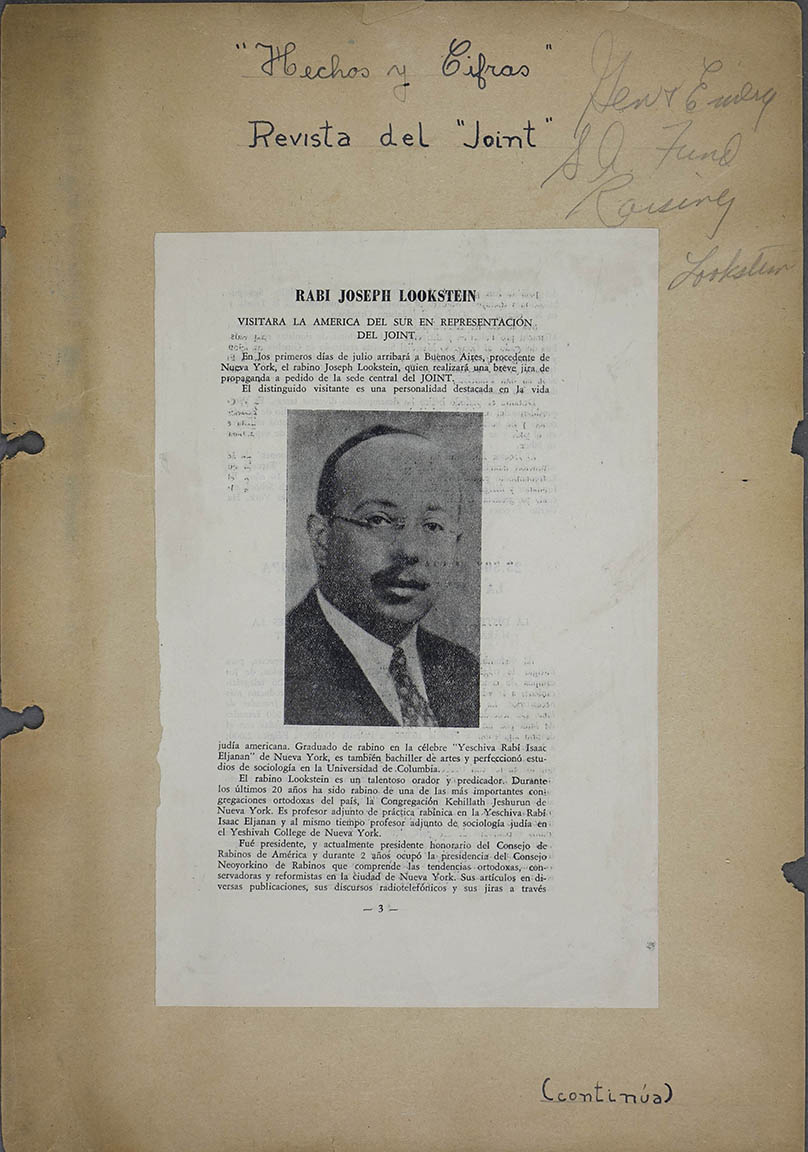
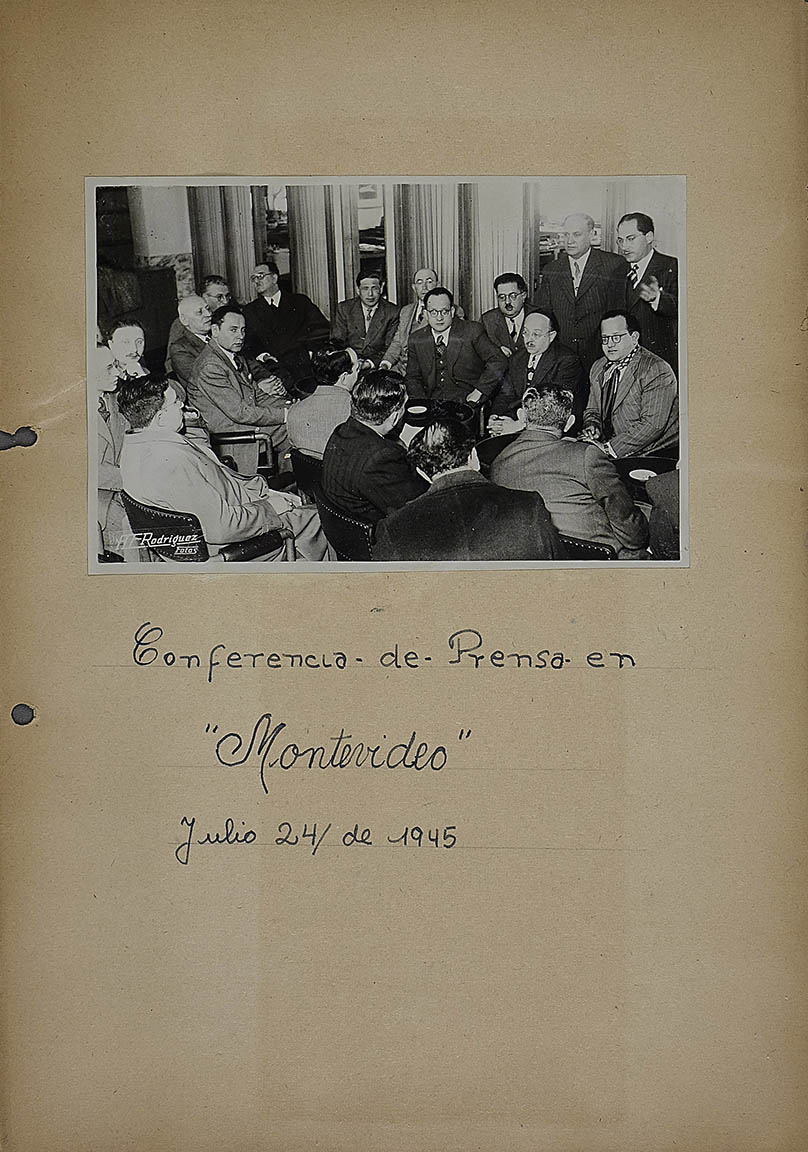
Pages from “Rabbi Joseph Lookstein’s Tour of South America” scrapbook , ca. 1945. JDC Archives
A record of his trip exists in the form of a scrapbook comprised of photographs, cards, invitations, and newspaper clippings spanning his journey from July to August of 1945 throughout Latin America. Just one of many scrapbooks present in the JDC Archives Artifacts and Ephemera Collection, these albums played an important role in documenting JDC’s activities over the years. In an era before digital archives, scrapbooks helped preserve photographs of fieldwork, newspaper clippings about missions, as well as letters, memos, and official documents pertaining to specific events and operations. Within the Lookstein scrapbook, photos capture his meetings with various groups, while Yiddish and German newspaper clippings announce his arrival. Reporting of this nature was essential for tracking projects and remembering where resources had been deployed.


Pages from “Rabbi Joseph Lookstein’s Tour of South America” scrapbook, ca. 1945. JDC Archives
Additionally, scrapbooks were useful tools in illustrating the impact of JDC operations to donors and the public. Invitations saved in the scrapbook reflect the types of speaking engagements that occurred. One card is an invitation to a reception and cocktail party held at the White Room of the Sociedad Hebraica Argentina (Argentine Hebrew Society), a vital cultural institution for Argentina’s Jewish community, which promoted secular Jewish identity, education, and integration into Argentine civic life. While another announces a lecture given by Lookstein at the Teatro Gran Splendid hosted by the Junta de Ayuda a las Victimas de la Guerra or (the Relief Committee for Victims of the War) in Buenos Aires. In the postwar period, the Jewish community of Argentina contributed funds and supplies to JDC’s relief campaign for European Jews through the Junta de Ayuda a las Victimas de la Guerra. The formality of these invitations indicates the importance placed on the events and attests to the strong partnerships that existed between JDC and the Jewish community of Argentina. Beginning in the mid-1930s, Jewish refugees fleeing Nazi Germany had begun arriving in Argentina in growing numbers. In fact, between 1933 and 1944, approximately 40,000 Jewish immigrants entered the country. At the time, Argentina had the largest and most established Jewish community in Latin America, which enabled local aid committees to effectively organize support for the arriving refugees. Between 1936 and 1944, JDC also contributed small annual grants to help expand child-care facilities at a home for refugee children, further supporting the burgeoning population.
During Lookstein’s visit, he attended numerous meetings and informed the Jewish communities he visited of the immediate relief and reconstruction needs of Jews in Europe. He also reported on the work JDC was doing in Eastern Europe to help devastated communities get back on their feet. By saving publicity, press, and photos, scrapbooks such as this provided tangible proof of mission work and evidence of fiscal and moral responsibility, which helped build trust through transparency.

JDC officers and other Argentinean Jews in warehouse in front of crates and barrels of oil for shipment to Jews in Poland, Buenos Aires, Argentina, ca. 1946. Photograph: Cine-Foto “ASTRA,” Buenos Aires. JDC Archives (NY_07556)
Lookstein recounted that the Jews in Latin America were very interested in the fate of their brethren and felt a strong attachment to American Jewry by partnering with JDC. Following his visit, he reported that “the 600,000 Jews in Latin America are anxious to join with American Jewry in extending every possible aid to impoverished Jews in Europe.” Due to an influx of Jewish refugees during the previous 12 years, an increased interest in Jewish traditional life, learning, and communal responsibility was felt throughout the communities and during the first six months of 1945, the Jewish communities of South America raised nearly $200,000 for the relief of the liberated Jewish communities in Europe.
Scrapbooks within the JDC Archives have become valuable historical artifacts that offer firsthand insight into the day-to-day operations of JDC’s global work, showing how aid was delivered in different regions, as well as the lived experiences of staff, volunteers, and aid recipients. Other examples of scrapbooks within the collection are JDC’s Dominican Republic Settlement Association (DORSA) logbooks, which are filled with photos and diary entries vividly describing the development of the agricultural settlement JDC set up for Jewish refugees in Sosúa, Dominican Republic during World War II.

Logbook of the Dominican Republic Settlement Association (DORSA), showing the arrival of the first settlers told in pictures, ca. 1940’s. JDC Archives
In sum, scrapbooks were more than keepsakes—they were strategic tools for visibility, accountability, and historical preservation during a critical time in global humanitarian work.
Rabbi Lookstein’s scrapbook was rehoused thanks to a 2021 Preservation Assistance Grant from the National Endowment for the Humanities (NEH). Any views, findings, conclusions, or recommendations expressed in this article do not necessarily represent those of the National Endowment for the Humanities.